
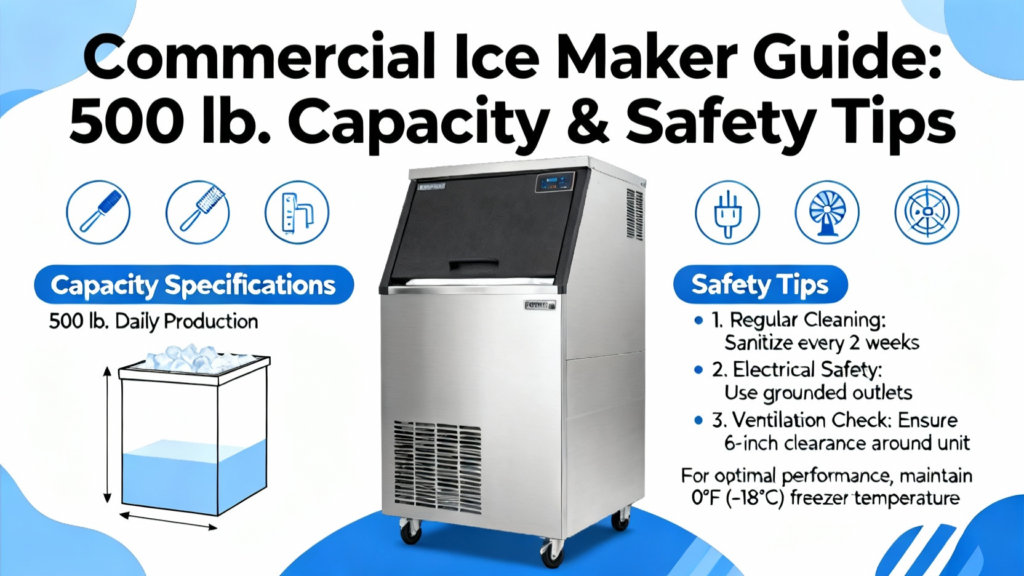
For restaurants, bars, and hotels, a reliable ice maker is essential. This guide explores the key features, installation requirements, and safety protocols for a heavy-duty 500 lb./24h capacity stainless steel commercial ice maker. Understanding these details ensures optimal performance, longevity, and safe operation in your demanding business environment.
Engineering for Commercial Durability and Efficiency
Built for high-volume operations, this ice maker’s stainless steel construction offers superior corrosion resistance and easy cleaning, meeting the stringent hygiene standards of the foodservice industry. Its 780W, 110V/60Hz power specification is designed for standard US commercial kitchens, balancing energy draw with robust output. Notably, it utilizes R290 (propane) refrigerant, an environmentally friendly option with a low Global Warming Potential (GWP). As noted on Wikipedia, hydrocarbons like R290 are gaining favor as sustainable alternatives to traditional HFCs, though they require careful handling due to flammability. This aligns with the unit’s Safety Protection Type I classification, indicating built-in safeguards for this refrigerant type.
Its compatibility with climate types SN, N, and ST (Sub-Normal, Normal, and Sub-Tropical) ensures reliable performance across varied US regional environments, from cooler northern states to warmer southern locales.
Critical Installation and Setup Protocols
Proper installation is non-negotiable for performance and safety. The unit requires a potable drinking water supply with precise pressure between 14.5-58 psi. Pressure outside this range necessitates a changeover valve to prevent mechanical issues. A gravity-fed drainage connection is mandatory, as meltwater and wastewater are continuously expelled; the drain outlet must be lower than the machine’s port.
Ventilation is crucial. A minimum 5.9 inches (15 cm) of clearance on all sides allows for essential airflow, preventing compressor overheating and efficiency loss. As discussed in a Reddit thread on refrigeration from November 2023, improper clearance is a common installer error leading to premature system failure. Furthermore, the location must be away from direct sunlight, stoves, or radiators, as ambient temperature directly influences ice production cycles.
Essential Safety and Operational Guidelines
Adhering to safety guidelines protects your investment and premises. Key mandates include:
- No cord extensions: The included 70″ three-prong plug must connect directly to a grounded outlet. Extensions can overheat, creating a fire risk.
- Keep away from flammables: The compressor and electrical components generate heat, necessitating distance from combustible materials.
- Indoor use only: The unit is not rated for outdoor conditions, which can affect electrical safety and component integrity.
- Water only: Using any liquid other than water to make ice can damage the system and create contamination hazards.
A critical step is the 24-hour settling period after delivery. The unit must remain upright to allow the refrigeration oil and R290 refrigerant to settle, preventing compressor damage upon start-up. This is a standard industry practice, especially for units using hydrocarbon refrigerants.
Maximizing Long-Term Performance and Output
To ensure the machine delivers its promised 500 lb./24h capacity consistently, ongoing attention is required. The environmental temperature significantly impacts freeze cycles; production times will vary seasonally in non-climate-controlled spaces. Regular cleaning and descaling, as per the manufacturer’s schedule, prevent mineral buildup that reduces efficiency and ice quality. The durable stainless steel build of models like the 23.2 in. 500 lbs./24h Capacity Commercial Stainless Steel Ice Maker is designed for this maintenance regimen. Monitoring ice quality and production rate provides early warning of potential issues, such as low water pressure or needed filter changes.
In conclusion, this heavy-duty commercial ice maker represents a significant investment for any foodservice business. Its stainless steel durability, efficient R290 refrigerant system, and high output capacity make it a powerful tool. However, its reliability is wholly dependent on correct installation—including proper water pressure, drainage, and ventilation—and strict adherence to safety protocols like the 24-hour settling period and using only a grounded outlet. By understanding the engineering behind its climate compatibility and the reasons for each operational guideline, owners and operators can fully leverage the machine’s capabilities. Ultimately, the consistent performance of a well-maintained commercial ice maker not only supports daily operations but also safeguards customer satisfaction and business continuity.
This guide really highlights why a reliable **commercial ice maker** is a must-have for keeping operations running smoothly.
\}}
This guide really highlights why a reliable **commercial ice maker** is a must-have for keeping operations running smoothly.
\}}
This guide really highlights why a reliable **commercial ice maker** is a must-have for keeping operations running smoothly.
\}}
This guide really highlights why a reliable **commercial ice maker** is a must-have for keeping operations running smoothly.
\}}
This guide really highlights why a reliable **commercial ice maker** is a must-have for keeping operations running smoothly.
\}}
This guide is super helpful for understanding the key features and safety protocols needed for a reliable 500 lb. commercial ice maker.
\}}
This guide is super helpful for understanding the key features and safety protocols for a 500 lb. commercial ice maker.
\}}
This guide is super helpful for understanding the key features and safety protocols for a 500 lb. commercial ice maker.
\}}
This guide is super helpful for understanding the key features and safety protocols for a 500 lb. commercial ice maker.
\}}