
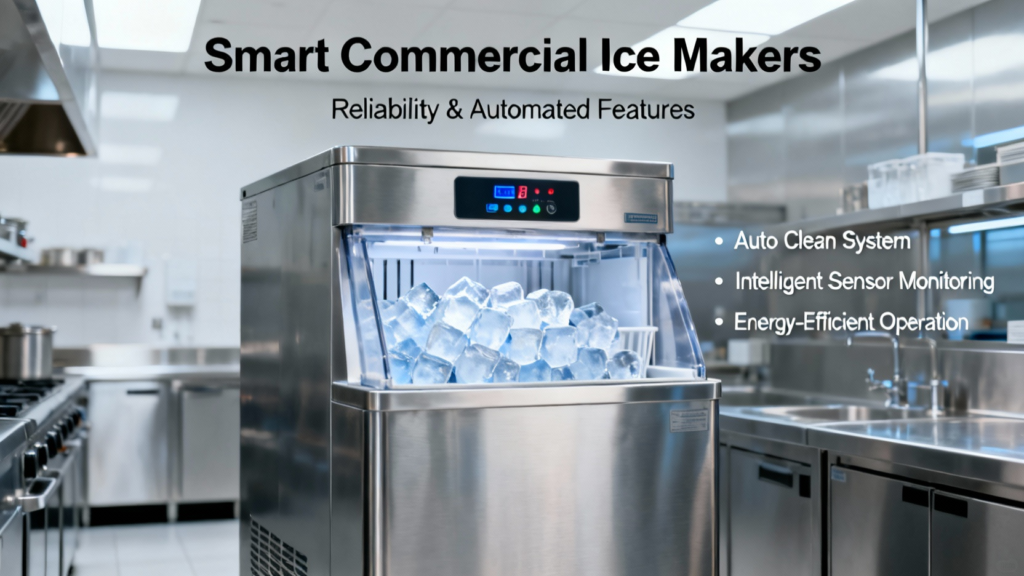
For any business that relies on a steady supply of ice, machine failure is more than an inconvenience—it’s a direct threat to operations and revenue. This article explores the critical features of modern commercial ice makers, with a focus on the Tittla 24-hours Split Commercial Ice Maker, that transform them from simple appliances into intelligent, reliable partners. We will delve into how smart alerts, automated maintenance, and user-centric design work in concert to ensure uninterrupted production, superior ice quality, and operational peace of mind.
Intelligent Operation and Proactive Alerts
Modern commercial ice machines integrate smart technology to prevent downtime. Key to this is the fault alert system, which acts as an early warning system for mechanical or electrical issues, allowing for proactive maintenance before a complete breakdown occurs. This is complemented by a water shortage alert, a critical feature that safeguards the unit’s pump and components from running dry, which can cause irreversible damage. As noted in a discussion on commercial kitchen equipment, “A low water cutoff or alert is non-negotiable for an ice maker in a commercial setting… it saves thousands in repairs” (Reddit, r/KitchenConfidential, 2023-08-14). These alerts, often displayed on an intuitive touch control panel, empower staff to address issues swiftly, ensuring the machine’s primary function—making ice—continues uninterrupted.
Automated Maintenance for Consistent Performance
Consistency is paramount, and it is achieved by removing manual tasks from the equation. The auto defrost function is a prime example. By periodically melting frost buildup on the evaporator coils, it maintains peak efficiency and ice production quality without staff intervention. This automation extends to hygiene with an integrated water filter, which removes sediments and impurities to ensure the ice is clean and clear. Furthermore, the inclusion of dual drainage options—water pump drainage for the main unit and gravity drainage for the storage bin—simplifies cleaning and sanitization cycles, a vital practice outlined in food safety guidelines. Wikipedia’s entry on Ice Machines emphasizes that regular cleaning and descaling are essential to prevent microbial contamination and mineral scale, which reduce efficiency.
Design for Capacity, Access, and Stability
The physical design directly impacts usability and output. A high-capacity unit like the 22.3 in. 450 lbs. /24h Ice Capacity 300 lbs Split Commercial Ice Maker is engineered for high-demand environments. Its large storage bin, capable of holding 300 lbs. of ice, is paired with a discreet ice full alert to prevent overflow and waste. User-centric touches include the flip-up ice bin door and included ice scoop for quick, hygienic access, and the blue lighted storage bin that provides both ambiance and a clear visual indicator of ice levels. Stability is ensured by 4-adjustable feet, which allow for perfect leveling on uneven floors, eliminating vibration and ensuring the unit operates as designed.
The Critical Role in Commercial Settings
In bars, restaurants, hotels, and healthcare facilities, ice is a utility. The consequences of an ice machine failure are immediate: disrupted service, potential loss of inventory, and negative customer experiences. A reliable machine with a high daily production rate (e.g., 450 lbs.) and smart safeguards isn’t just an appliance; it’s insurance. As one hospitality manager shared, “Our new ice maker’s fault alert once flagged a minor compressor issue. We had it fixed during slow hours and never lost a day of service. That alert paid for itself” (Reddit, r/restaurateur, 2024-01-22). This underscores the shift from viewing ice makers as commodity equipment to recognizing them as integral, intelligent components of a smooth operation.
In conclusion, selecting a commercial ice maker today requires looking beyond basic production numbers. The integration of intelligent systems—from proactive fault and water alerts to automated defrosting—represents a significant leap in operational reliability and food safety. These features, combined with thoughtful design elements like stable adjustable feet, lighted bins for easy monitoring, and hygienic access points, create a machine that actively supports your business rather than posing a recurring risk. The high-capacity Tittla Split Commercial Ice Maker exemplifies this modern approach, where technology handles maintenance and monitoring, freeing staff to focus on service. Ultimately, investing in an ice maker with these comprehensive features is an investment in consistency, efficiency, and peace of mind, ensuring that one of your operation’s most critical utilities is always flowing.
The Tittla 24-hour model you highlighted really shows how automated features in a commercial ice maker can be a total game-changer for business reliability.
\}}
The Tittla 24-hour model’s automated features seem like a smart way to prevent the costly downtime the article mentions.
\}}
The Tittla’s automated features sound like a game-changer for keeping operations running smoothly without the constant worry of ice maker failure.
\}}
The Tittla’s automated features sound like a game-changer for keeping operations running smoothly without the constant worry of ice maker failure.
\}}